ZBrain
Last updated:
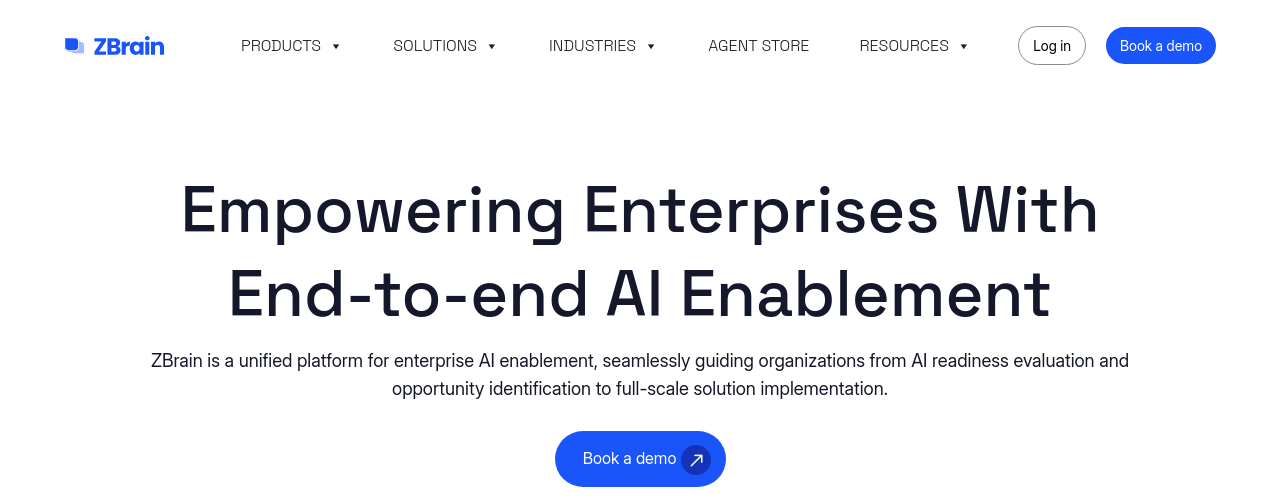
ZBrain is a full-stack enterprise AI platform by LeewayHertz that takes organizations from AI readiness assessment through to deployed, production-grade AI agents. Rather than offering a single use case, it handles the entire lifecycle: evaluating where AI creates the most value, building the solution with a low-code interface, and deploying it into existing business workflows. The platform runs on a model-agnostic LLM layer supporting GPT-4, Claude, Llama-3, Gemini, and custom private models. You bring your proprietary data — from databases, cloud storage, and APIs — and ZBrain ingests it into a private, secure knowledge base with optimized retrieval. AI agents handle complex multi-step tasks, process automation, and decision support across finance, HR, legal, sales, and customer service. ZBrain has two primary product lines: ZBrain AI XPLR for readiness assessment and roadmap building, and ZBrain Builder for low-code AI agent development. The platform integrates with Slack, Microsoft Teams, MySQL, MongoDB, and Amazon AWS. Continuous improvement through RLHF keeps outputs aligned with real-world feedback. Pricing starts at $999 per month for the Growth plan, with Enterprise at custom pricing.
How It Works
ZBrain starts with the AI XPLR readiness framework, which identifies high-value processes for AI integration, maps data availability, and produces a structured deployment roadmap. Once target processes are defined, ZBrain Builder provides a low-code interface for creating AI agents without engineering overhead. Agents can be built from scratch or selected from a prebuilt library spanning common enterprise use cases. The ZBrain Engine handles business logic execution, LLM routing, data governance, and real-time integrations. The model-agnostic layer routes tasks across GPT-4, Claude, Llama-3, and Gemini based on task requirements or user configuration. The private knowledge base ingests structured and unstructured data from databases, cloud storage, and file systems. Retrieval is optimized through vector storage and ontology-based organization. Human-in-the-loop feedback through RLHF continuously improves agent accuracy. Enterprise controls including role-based access, data governance, and compliance guardrails are built into the platform architecture.
Key Features
- ✓ZBrain Builder: Low-code interface for building custom AI agents and automated workflows without engineering overhead
- ✓ZBrain AI XPLR: AI readiness assessment framework that maps high-value processes and builds a deployment roadmap
- ✓Agent Crew: Coordinate multiple specialized AI agents on complex multi-step enterprise tasks
- ✓Model-agnostic LLM layer: Supports GPT-4, Claude, Llama-3, Gemini, and private models with intelligent routing
- ✓Private enterprise knowledge base: Ingest proprietary data from databases, cloud storage, and APIs into a secure retrieval layer
- ✓Multi-source data integration: Connect MySQL, MongoDB, Amazon AWS, Google Cloud, and 50+ enterprise systems
- ✓RLHF continuous improvement: Human-in-the-loop feedback loop that continuously refines AI output quality over time
- ✓AI workflow automation: Pre-built and custom workflow components for automating repetitive business processes
- ✓Slack and Teams integration: Deploy AI agents directly into existing communication tools without custom development
- ✓Role-based access controls: Enterprise-grade governance for data permissions and agent access management
- ✓Evaluation suites and guardrails: Built-in quality controls that verify AI outputs before they reach end users
- ✓Industry use case library: Pre-built AI agents for finance, HR, legal, sales, and customer service workflows
- ✓MCP server integration: ZBrain supports Model Context Protocol for expanded agent connectivity
Best For
Frequently Asked Questions
Does ZBrain require AI engineering expertise to use?
ZBrain is built as a low-code platform so business users and operations teams can configure AI agents without writing code. Technical teams have access to deeper configuration options, but the core Builder interface is designed for non-engineers to work independently.
What data sources can ZBrain connect to?
ZBrain supports MySQL, MongoDB, Amazon AWS, Google Cloud, file systems, and APIs. It also integrates with Slack, Microsoft Teams, and Pipedrive. Data stays in your private knowledge base and is not shared with model providers, which matters for regulated industries.
Is ZBrain model-agnostic?
Yes. The platform routes tasks across GPT-4, Claude, Llama-3, Gemini, and private models based on task requirements. You can configure a default model per workflow or let ZBrain route dynamically based on cost, speed, or quality criteria.
What does the Growth plan include?
The Growth plan starts at $999 per month and runs on a credit system. Five credits are charged as a baseline per workflow execution, plus variable costs for advanced features. The Enterprise plan removes credit metering entirely with unlimited usage.
How does ZBrain handle data security?
ZBrain processes data in a private enterprise knowledge base that does not share information with external model providers. The platform includes role-based access controls, data governance features, compliance guardrails, and support for industry security standards.
Pricing
Growth
- 200,000 credits per month
- 5 credits per workflow execution
- 5 GB knowledge storage
- API access
- Email support
Enterprise
- Custom SSO
- Unlimited builder users
- Unlimited integrations
- Deployment assistance
- InfoSec review
- API access
- Priority email support